

Introduction
When you have just created your site and implemented Google Analytics or a marketing pixel, it is highly likely that you have encountered both the cookie banner and the cookie policy. These two are often used interchangeably. But they are not.
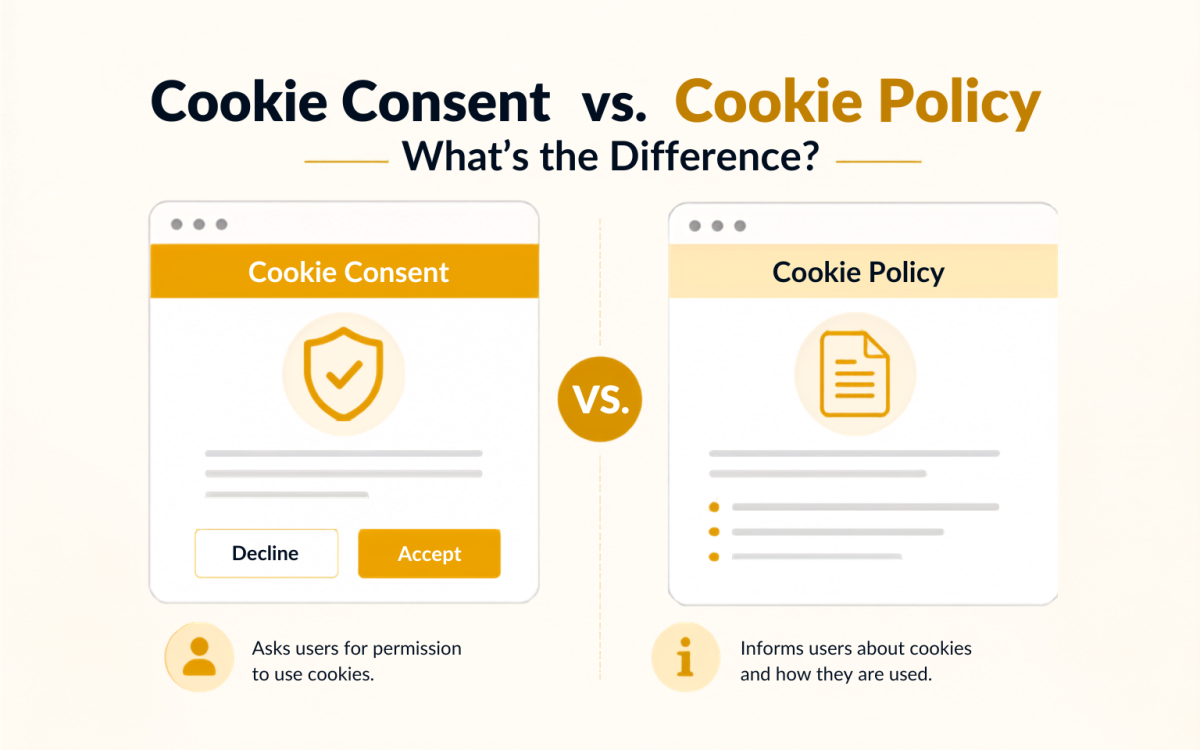
While one requests your permission, the other informs about what is going on. Getting confused between the two is one of the most common causes for website non-compliance with regulations.
Quick Answer
Cookie consent is the banner that asks for your permission before the tracking takes place. Cookie policy is the document that tells you which cookies you are using, why you are using them, and how long they will stay on your computer. You need both to manage your consent properly. The policy educates you. The consent banner gathers your consent.
Why This Distinction Matters
When performing website reviews, the issue we see most frequently is not the absence of a cookie policy. It is the immediate loading of analytics and advertising cookies when users land on the site before they get a chance to accept or reject them.
The page of the cookie policy may be excellently written but still non-compliant because tracking starts too early. The policy does not grant permission.
Cookie Consent
Most users scroll past cookie notices without much thought about it. Yet, the little box that pops up is what will determine legality of tracking activity for the website owner.
In order for the consent to comply with GDPR and the UK’s version of it, a few clear criteria must be satisfied:
- Free – there should be no pre-checked boxes, and acceptance of cookies cannot be made compulsory just to use the website;
- Specific – cookies that provide analysis functions and those providing for advertisement are distinct, hence “Accept All” button is unacceptable;
- Informed – website visitor must know what he or she is signing up for;
- Right to easily withdraw – it must be as easy to refuse consent as to give it.
This is precisely why modern cookie banners come with the three clearly defined buttons “Accept,” “Reject,” and “Manage Preferences” with equal ease to select any of them. Gone is the old “Got it!” button that basically assumed your consent. It was popular five or six years ago. It’s not surprising that it is rare now since regulators have fined companies for its use.
Cookie Policy
The cookie policy operates more like the nutritional label. It does not prevent the existence of the cookies. It only informs users about the ingredients.
Typical cookie policy should include the following:
- What cookies and other technologies (pixels, local storage, etc.) are used on the website
- Whether each cookie is essential or non-essential
- Whether the cookie is set by you or a third party such as Google or Meta
- The expiration date of each cookie
- How users can control or remove cookies in their own browsers
- Some companies include this information in their overall privacy policy. Other companies provide
Cookie Consent vs Cookie Policy at a Glance
| Cookie Consent | Cookie Policy |
| Requests user permission | Explains use of cookies |
| Displayed before cookie tracking starts | Located on a separate page |
| Needed before non-essential cookies | Needed for transparency |
| Interactive banner | Informative document |
| Choice made by the user | User receives information |
Why You Need Both
This is where the conversation moves from definitions to actual risk.
A well-written cookie policy cannot fix a banner that lets Google Analytics or Meta Pixel load before anyone has clicked anything. The policy describes what you’re doing. It does not authorise you to do it.
The reverse is also a problem. A consent banner with no proper policy behind it leaves visitors with nothing real to read. Regulators expect the banner to link to clear, accurate information.
Modern enforcement focuses heavily on how consent is collected, not just whether a policy page exists. Proper consent management means both pieces work together.
Common Cookie Compliance Mistakes
Here are the issues that keep appearing in audits:
- Treating the cookie policy as if it replaces cookie consent
- Using pre-checked boxes (these do not count as valid consent under GDPR)
- Making “Accept” easy and “Reject” hard
- Leaving the policy outdated after adding new tracking tools
- Blocking the entire site until visitors accept everything
- Any one of these can undermine otherwise good intentions.
The Future of Cookie Compliance
Regulatory attention is not slowing down. Beyond the EU and UK, more US states (California, Colorado, Virginia and others) have introduced their own rules around tracking and opt-outs. At the same time, browsers continue to restrict third-party cookies.
The direction is clear: websites are being pushed toward clearer, consent-based approaches and greater reliance on first-party data. If you have visitors from the UK or Europe, the baseline is a current cookie policy plus a properly working cookie consent system that actually blocks non-essential cookies until a choice is made.
How to Check Your Own Site
Ask yourself two separate questions:
- Is my cookie policy accurate and up to date with the tools I’m actually using?
- Does my cookie consent banner block non-essential cookies until the visitor makes a real choice?
Whichever answer feels weaker is the place to start improving.
Conclusion
A cookie policy tells people what you’re doing. Cookie consent gives them the power to say no before it happens. You can technically run a site with only one of thembut you shouldn’t. Depending on where your visitors come from, doing so can put you outside the rules.
Good consent management isn’t about adding more legal text. It’s about giving people a clear, fair choice and then respecting that choice. When both the banner and the policy work together, you protect your site and build a bit more trust at the same time.
That’s the practical standard most websites should be aiming for in 2026.
Win Visitor’s Trust Through Cookie Transparency
Offer visitors genuine privacy control while keeping your site up-to-date in terms of modern data protection standards.
Frequently Asked Questions
You still need the banner. The policy explains your practices; it doesn’t give you legal permission to place cookies. Under GDPR and similar laws, you need real, active consent before non-essential cookies load, in addition to a clear policy on the back end.
If you’re using anything beyond strictly necessary cookies, analytics, ad trackers, that kind of thing and any visitors fall under GDPR, CCPA, or similar laws, then yes. Business size doesn’t factor into it.
Whenever your actual cookie usage changes, a new analytics tool, new ad network, that sort of thing. Beyond that, a check every six months or so is a decent habit, just to catch anything that slipped through.
Non-essential cookies shouldn’t load at all. Only the strictly necessary ones the stuff that keeps basic site functions working, like remembering what’s in a cart are allowed to run without explicit consent.
