
Introduction
If you’ve visited a website, you’ve probably seen a cookie banner pop up. Many visitors accept cookies without stopping to read the message. That cookie banner isn’t there by accident; it’s how a website asks for your permission before using certain cookies on your device.
What Is GDPR?
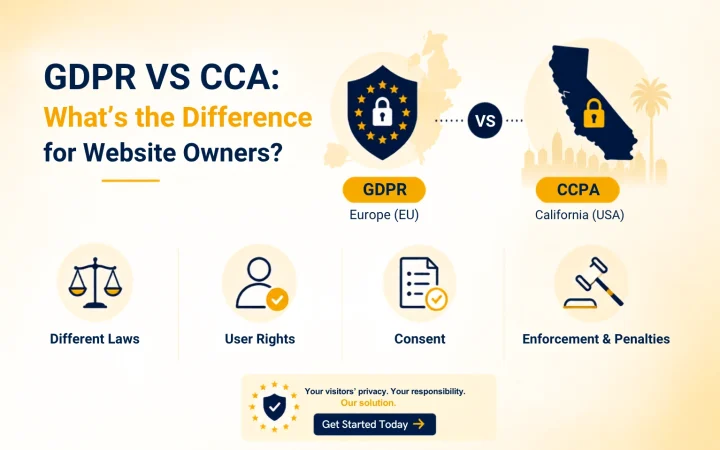
The General Data Protection Regulation (GDPR) is a privacy law introduced by the European Union in 2018 to protect people’s personal information. It sets the rules for how companies can collect, store, use, and protect personal information belonging to people in the EU. There was no such thing yet, but each country in Europe more or less had its own privacy laws which did not correspond to each other. GDPR made all of these irrelevant and replaced them with a single standard.
The law exists because, for years, companies treated personal data like an open resource. They collected it, used it however they wanted, and answered to no one. At its core is a fairly straightforward idea: your data is yours. Not the company’s, just because they managed to collect it. Even companies outside the EU may need to follow GDPR if they collect data from EU residents. Asking for consent gives visitors control over how their information is used. That’s one of the main goals of GDPR.
Why Does GDPR Require Cookie Consent?
Cookie banners on European websites exist due to privacy laws, giving citizens the right to decide how their personal information is collected and used. To place non-essential cookies on the device of the visitor, websites should seek the permission of the user first.
Reasons
Cookies are capable of collecting personal data.
IP addresses, device IDs, browser settings, and browsing habits might be counted as personal data in accordance with GDPR.
Consent is needed for using non-essential cookies.
The analytics, advertising, personalization, and marketing cookies generally need to receive permission from the visitor to be placed on the website.
It should be an informed decision.
Legally valid consent must be given by an affirmative action. Pre-checked boxes, implicit consent, and further browsing are not legitimate ways of receiving consent.
Choice should be genuine.
Acceptance and refusal of non-essential cookies must be equally convenient for users.
e-Privacy Directive works in conjunction with GDPR.
e-Privacy Directive mandates to obtain consent prior to placement of most non-essential cookies. GDPR, in turn, prescribes the requirements for processing personal data and obtaining consent.
What Should a GDPR-Compliant Cookie Banner Include?
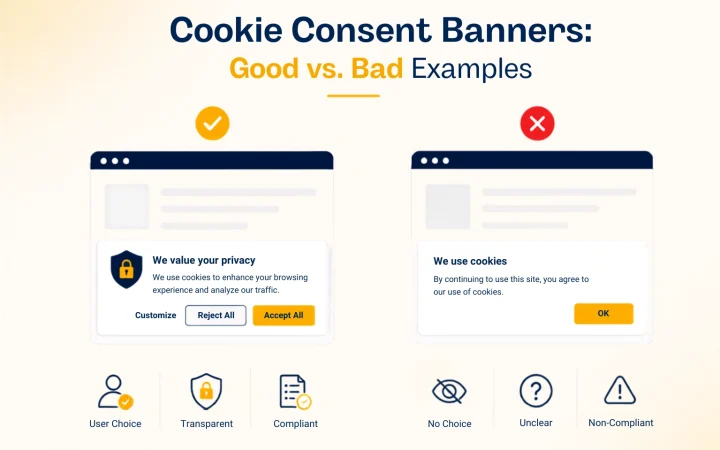
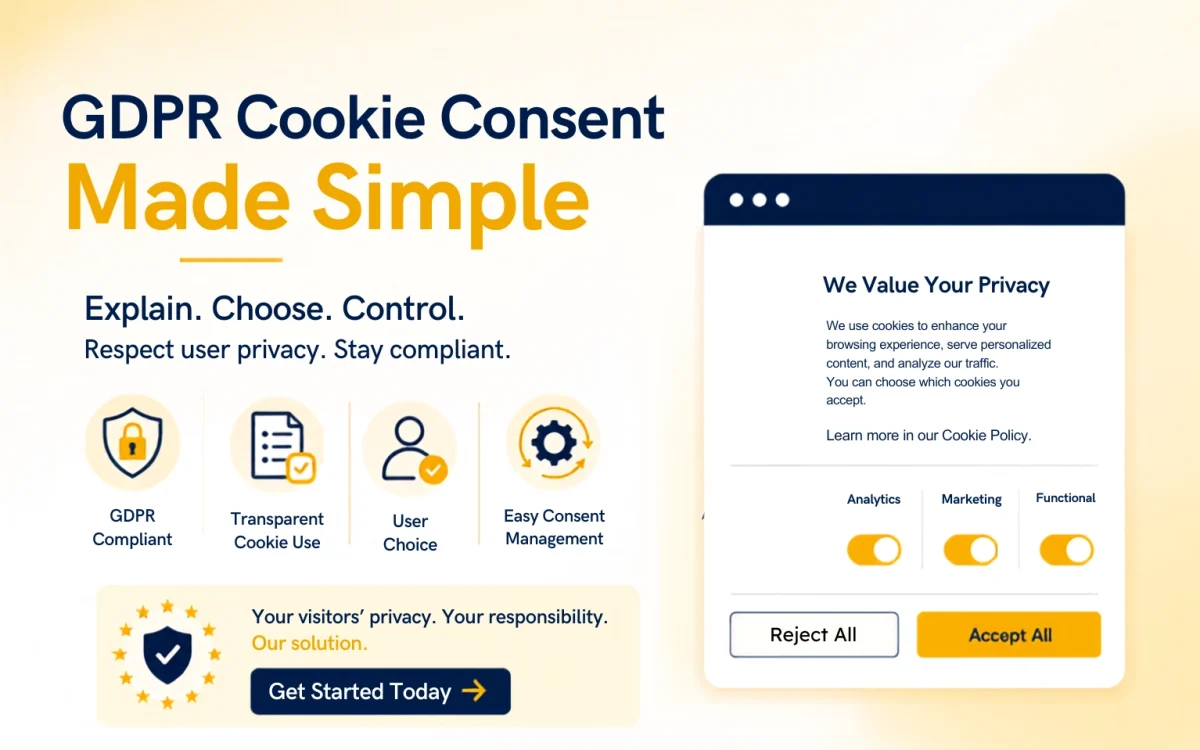
A GDPR-compliant cookie banner should give visitors clear information and a real choice before non-essential cookies are used. It should be simple, transparent, and easy to use.
- Describe Cookie Use
Explain in detail why your website is using cookies and how their use will enhance its functionality/security/operation/performance/user experience.
- Cookie Options
Provide options to users to select cookie categories which they wish to allow rather than forcing them to accept all of them.
- Cookie Categorization
Categorize cookies in straightforward categories like Essential, Analytics, Functional, and Marketing.
- Block Non-Essential Cookies Until Consent Is Given
Do not allow loading of cookies related to analytics, advertisements, personalization, and other non-essential purposes until consent has been given.
- Make Cookie Policy Available
There must be a link to the Cookie Policy available to explain what cookies are used, for what purpose, how long do they stay on the device of visitors, and how can visitors update or withdraw their consent.
- Make It Easy to Update Consent
Allow users to update and revoke consent at any point in time by offering them access to the Cookie Settings / Manage Consent section.
Common GDPR Cookie Consent Mistakes to Avoid
- Placing cookies before consent is granted
Do not put analytics, marketing, or advertising cookies until the visitor has explicitly accepted to use these cookies.
- Not offering the option to reject cookies
Ensure that the Accept and Reject buttons are equally displayed so that visitors can actually choose.
- Providing pre-selected cookie options
Selection of cookie categories beforehand is something that must not be done as consent is voluntary.
- Hiding cookie preferences
Allow the visitors to easily change their cookie preferences whenever needed. - Using Complex Language
Ensure that your cookie policy is written in clear and understandable language.
- Maintaining an old list of cookies
Periodically check your website and make updates to your cookie policy as necessary whenever you add or remove cookies. - Collecting more information than necessary
Utilize only those cookies that are needed for the intended purpose of your website.
- Classifying all cookies as essential
Cookies which are strictly required to make your website work should only be classified as essential.
- Failing to update your knowledge about privacy laws
Check your cookie banner, consent management, and privacy policy for compliance with GDPR and other changes in privacy laws.
GDPR Cookie Consent Best Practices for Website Owners
| Best Practice | Reason for Implementation |
| Make the cookie banner clear and simple | Use clear and short language to ensure that the visitors easily understand their choices. |
| Offer options for consent | Enable the visitors to consent to or refuse non-essential cookies equally. |
| Block non-essential cookies until consent is given | Block the loading of any analytical, marketing, and advertising cookies until the visitors give permission. |
| Update the cookie banner regularly | Update the cookie banner, cookie policy, and consent mechanism every time there is a change in the website or privacy laws. |
| Keep your cookie policy updated | Always update the cookie policy with regard to the new cookies, technologies, and practices on your website. |
| Value visitor’s privacy | A transparent consent process increases trust and shows how much you respect the visitors’ privacy. |
| Comply with privacy laws | Conforming to GDPR cookie consent requirements will decrease compliance risks. |
| Increase user experience | A good consent banner will improve the browsing experience of the visitors. |
Stay compliant and protect your visitors’ privacy with our easy-to-use Cookie Consent solution. Get started today.
Frequently Asked Questions
The need to get the consent of website visitors prior to setting cookies for analytics and other reasons on their devices is essential.
Yes. Even though you are not in the EU/EEA, GDPR can be applicable to your business if your website obtains information from individuals in the EU/EEA.
Yes. Visitors must be able to alter their cookie consent any time they wish via cookie settings.
Cookies related to analytics, advertisements, personalization, and social media usually require consent from users. Essential cookies that are required for the operation of websites rarely require consent from users.
Yes. It is possible for visitors to change or revoke their cookie consent anytime they want using the cookie preference option provided on your site.