
Introduction
If you’ve recently launched a website, added Google Analytics, or installed a marketing pixel, you’ve probably encountered both a cookie banner and a cookie policy. They’re often treated as interchangeable, but they serve very different purposes.
During website compliance reviews, one of the most common issues we see isn’t the absence of a cookie policy, it’s that analytics and advertising cookies start loading before visitors have had the chance to make a choice. Even businesses with well-written privacy documentation can fall into this trap.
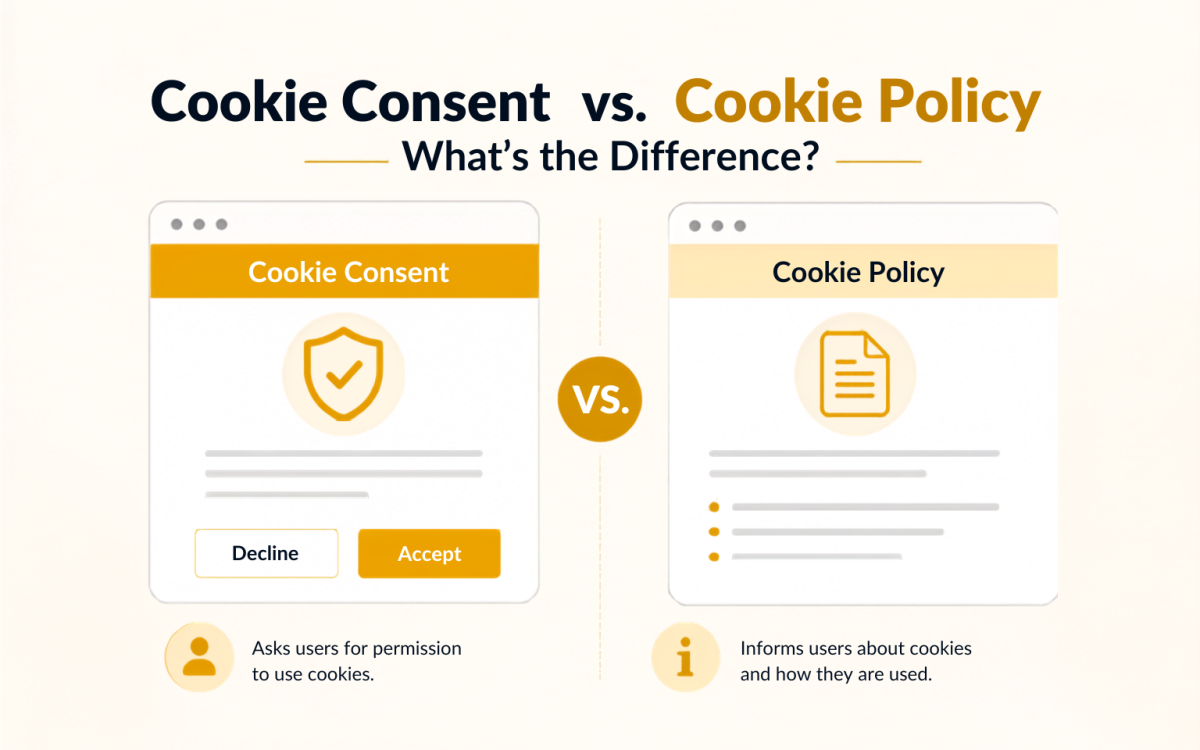
Cookie Consent
Most people click past a cookie banner without thinking. For website owners, though, that small pop-up determines whether tracking can legally begin. Under GDPR and the UK’s version of it, that permission has to check a few boxes:
- Freely given — no pre-selected boxes, no forcing people to accept cookies just to get past the homepage.
- Specific — analytics cookies and advertising cookies aren’t the same thing, and lumping them into one “Accept All” button doesn’t cut it.
- Informed — the visitor actually needs to understand what they’re agreeing to, not just click through.
- Easy to withdraw — if it takes one click to say yes and five to say no, that’s a problem.
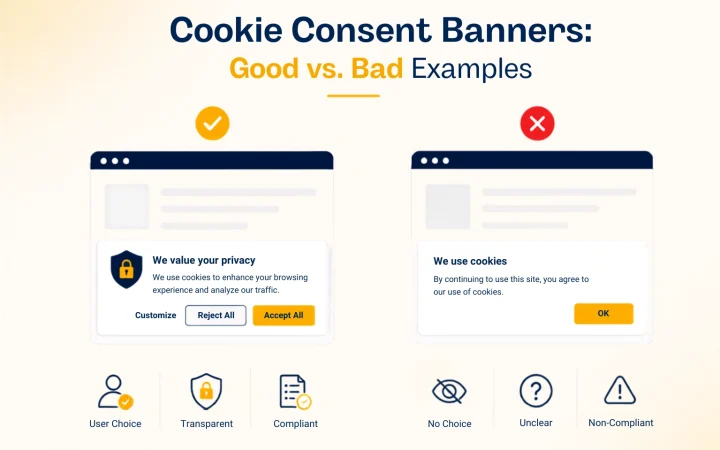
This is why you see banners now with “Accept,” “Reject,” and “Manage Preferences” as separate, equally easy options instead of the old single “Got it!” button that basically assumed you were fine with everything. That pattern was everywhere five or six years ago. It’s fallen out of favor for a good reason: regulators across Europe have specifically fined companies for using it.
Cookie Policy
A cookie policy works a bit like a nutrition label. It’s not stopping you from eating the food, it’s just telling you what’s in it. A solid cookie policy usually spells out:
- What cookies (and similar tech tracking pixels, local storage, etc.) the site actually uses
- Whether each one is essential or non-essential
- Who sets it you, or a third party like Google Analytics or a Facebook pixel
- How long each cookie sticks around before it expires
- How visitors can manage or clear cookies through their own browser
Some businesses fold all this into a broader privacy policy. Others give it its own page. Regulators don’t seem to care which route you take, as long as it’s specific and easy to find vague lines like “we use cookies to improve your experience” don’t really pass muster anymore.
| Cookie Consent | Cookie Policy |
| Requests user permission | Explains use of cookies |
| Displayed before cookie tracking starts | Located on a separate page |
| Needed before non-essential cookies | Needed for transparency |
| Interactive banner | Informative document |
| Choice made by the user | User receives information |
Why You Need Both
This is where it stops being a vocabulary exercise and starts being a compliance issue.
When auditing ecommerce sites, we frequently find Google Analytics and Meta Pixel loading before consent is recorded. You can have the best-written policy page on the internet, but if cookies are already loading the second someone lands on your site before they’ve clicked anything you’re still in breach. The policy explains what you’re doing. It doesn’t give you permission to do it.
The reverse is a problem too. A consent banner with no policy behind it leaves visitors with nothing to actually reference. Regulators expect that banner to link somewhere real, not just a “we use cookies, cool?” pop-up with zero follow-through.
Enforcement actions increasingly focus on how consent is collected rather than whether a website simply publishes a cookie policy. A well-written policy cannot compensate for a banner that allows tracking before visitors make a choice.
Common Cookie Compliance Mistakes
- Treating the policy as consent. Making a cookie policy and thinking it will suffice without a consent banner is another typical compliance error made by companies.
- Pre-checked boxes. Under GDPR, this simply doesn’t count as valid consent. It has to be an active choice.
- No easy opt-out. Accepting takes one click, rejecting takes five regulators to notice that kind of imbalance.
- Stale policy pages. Adding a new ad pixel or analytics tool and never updating the policy to match.
- Hard-blocking access. Forcing visitors to accept everything just to use the site several EU regulators have already flagged this as invalid.
The Future of Cookie Compliance
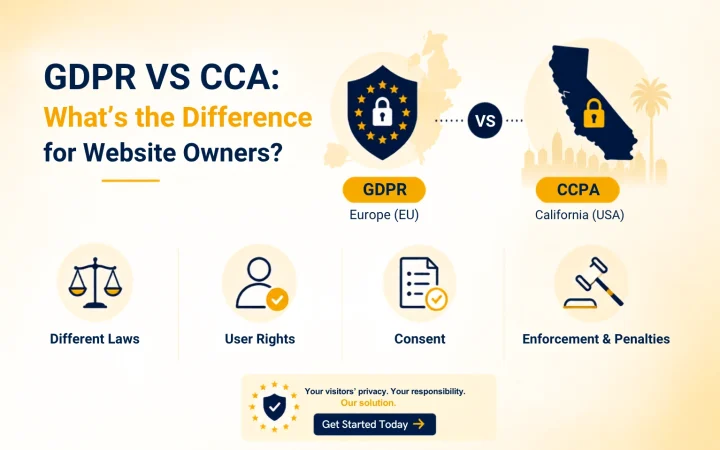
Regulatory attention here isn’t easing up. Beyond the EU and UK, a growing list of US states California, Colorado, Virginia, and others have rolled out their own rules on tracking and opt-outs. Add in Google’s ongoing changes to third-party cookie support in Chrome, and the direction is pretty clear: more sites are being pushed toward consent-based, first-party data setups no matter where they’re based. If you’ve got UK or EU traffic, the baseline is a clear cookie policy and a compliant, granular consent tool. Not one standing in for the other two separate pieces of the same picture.
Conclusion
A cookie policy tells people what you’re doing. Cookie consent gives them the power to say no before it happens. You can technically run a site with just one of these but you shouldn’t, and depending on where your visitors are, doing so could put you outside the law.
If you’re auditing your own site, ask two separate questions:
Is my policy accurate and current?
Does my consent banner actually block non-essential cookies until someone agrees?
Whichever answer feels shaky that’s where to start.
Win Visitor’s Trust Through Cookie Transparency
Offer visitors genuine privacy control while keeping your site up-to-date in terms of modern data protection standards.
Frequently Asked Questions
You still need the banner. The policy explains your practices; it doesn’t give you legal permission to place cookies. Under GDPR and similar laws, you need real, active consent before non-essential cookies load, in addition to a clear policy on the back end.
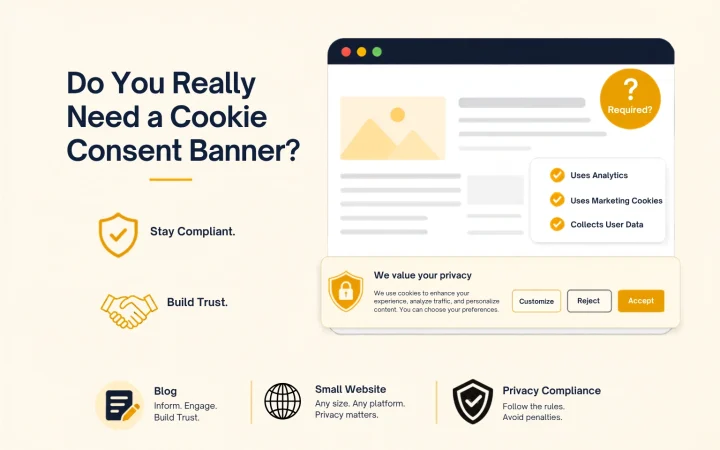
If you’re using anything beyond strictly necessary cookies, analytics, ad trackers, that kind of thing and any visitors fall under GDPR, CCPA, or similar laws, then yes. Business size doesn’t factor into it.
Whenever your actual cookie usage changes, a new analytics tool, new ad network, that sort of thing. Beyond that, a check every six months or so is a decent habit, just to catch anything that slipped through.
Non-essential cookies shouldn’t load at all. Only the strictly necessary ones the stuff that keeps basic site functions working, like remembering what’s in a cart are allowed to run without explicit consent.