

Introduction
You know that banner that pops up on almost every site now, asking you to accept /reject cookies? Most of us hit “Accept All” and move on with our day. Nobody has time to read a cookie policy before they can even see the article they clicked on. But if you’ve ever wondered what you’re actually agreeing to, or you’re building a website yourself and need to get this right, it helps to know that “cookies” isn’t really one thing.
So What Even Is a Cookie?
A cookie is just a small text file of a website stored in your browser. It’s not a program, it doesn’t run on its own, and it can’t access your device or steal your photos. It’s a sticky note the site leaves behind so it remembers you next time.
A cookie is simply a small piece of data stored by your browser, but its purpose can vary significantly. A single cookie might keep you signed in while you browse, another could remember your preferred language or accessibility settings, a different one may help website owners understand how pages perform, and others can be used to measure whether online advertising campaigns are effective.
Privacy laws such as the GDPR and e-Privacy Directive classify cookies according to their purpose because each category has different privacy implications and consent requirements.
Types Of Website Cookies
1.Necessary Cookies
These are the cookies a site literally cannot work without.
Say you log into your email. You type your password, enter, and now you’re in your inbox. As you click from email to email, something has to tell the site “yep, still the same logged-in person” otherwise you’d be typing your password again with every single click. That’s a necessary cookie doing its job.
You’ll also find this type behind the scenes in things like:
- Remember your login while you navigate between pages.
- Holding onto what’s in your shopping cart between pages
- Balancing server traffic so a busy site doesn’t crash
- Spotting suspicious or fraudulent login attempts
- Remembering the choice you made on the cookie banner itself, so it doesn’t pop up every five seconds
You add three items to your cart on an online store. A necessary cookie remembers those items while you continue shopping.
2.Functional Cookies
Functional cookies that don’t keep the lights on the site would still run without them but they’re what make your visit feel less annoying.
You don’t usually notice these until they’re gone. A site remembering that you prefer dark mode, or that you switched the language to Spanish last time, or that you like videos to play at 1080p instead of buffering on auto, that’s a functional cookie quietly doing its thing in the background.
A few places you’ll run into them:
- Remembering your language or region so you’re not resetting it every visit
- Saving display settings like font size or dark/light mode
- Pre-filling your username (never your password that’s handled differently, and more securely)
- Remembering your preferred video quality setting
You can block functional cookies without breaking anything major. You’ll just be resetting your preferences constantly, which gets old if it’s a site you visit often.
3.Analytics Cookies
Sometimes called performance or statistics cookies, this type is all about tracking how people use a site, not who you are individually, but what happens when people click around. Which pages get visited most. How long people stick around before leaving. Where they get stuck.
This is the data behind questions like: is the homepage confusing people? Has anyone actually finished reading that 2,000-word blog post? None of it is about targeting you personally, it’s about a site owner figuring out what’s working and what isn’t.
Common examples include:
- Google Analytics and similar traffic tools
- Heatmap software like Hotjar or Microsoft Clarity
- Cookies running A/B tests to see which version of a page performs better
- Tools tracking page speed or error rates
Blocking these won’t change your experience one bit. The only difference is the site owner loses visibility into what you did while you were there. For this reason, regulations such as GDPR require websites to receive your explicit permission before analytics cookies are activated, because monitoring user activity still qualifies as tracking, even if the information is anonymized.
4.Marketing Cookies
This is the category most people actually have a problem with, and honestly, it’s understandable. Marketing cookies follow you across different websites to build a picture of what you’re interested in, then use that picture to decide which ads to show you.
You know that moment where you look at a pair of hiking boots on one site, and suddenly you’re seeing hiking boot ads on Instagram, then YouTube, then some random news site three days later? That’s not a coincidence or a coded microphone conspiracy that’s a marketing cookie (usually planted by a third-party ad network) tracking your browsing across the web.
Typical examples:
- Facebook Pixel and comparable ad-retargeting tools
- Third-party cookies from ad networks like Google Ads
- Cookies tracking which ad or campaign actually brought you to the site
- Cross-site tracking used purely for retargeting
You can block these entirely and it won’t affect the site’s functionality at all. You’ll still see ads; they just won’t be built around your browsing history anymore. Because Safari and Firefox restrict many third-party marketing cookies by default, advertisers have had to rethink how they measure campaigns. Today, many organizations prioritize first-party data and privacy-friendly solutions that respect user choices while still providing useful insights.
Quick Word on First-Party vs Third-Party Cookies
“First-party” and “Third-Party” don’t have anything to do with the type of cookie they are simply descriptors that tell us who places the cookie. Whether the cookie is Necessary, Functional, Analytic or Marketing, it can be classified as either first-party or third-party.
| Feature | First-Party Cookies | Third-Party |
| Created By | The website you’re visiting | Another domain or third-party service |
| Use | Site functionality, personalization, etc. | Advertising, tracking |
| Example | Amazon storing your shopping cart data | Google Ads, Meta Pixel tracking etc. |
| Privacy | Privacy-friendlier | Privacy riskier |
| Consent | Only needed for non-essential cookies | Typically needs user consent |
| Browser Support | Supported across browsers | Less support in some browsers |
Why This Actually Matters If You Run a Site
If you own or manage a website, this isn’t just background trivia it affects what you’re legally required to do. Under GDPR in Europe, CCPA in California, and similar laws showing up elsewhere, the general rule of thumb is:
- Necessary cookies can load right away, no permission needed
- Functional, analytics, and marketing cookies need an actual opt-in before they load
- Visitors need an easy way to change their mind later, not just a one-time pop-up they can never revisit
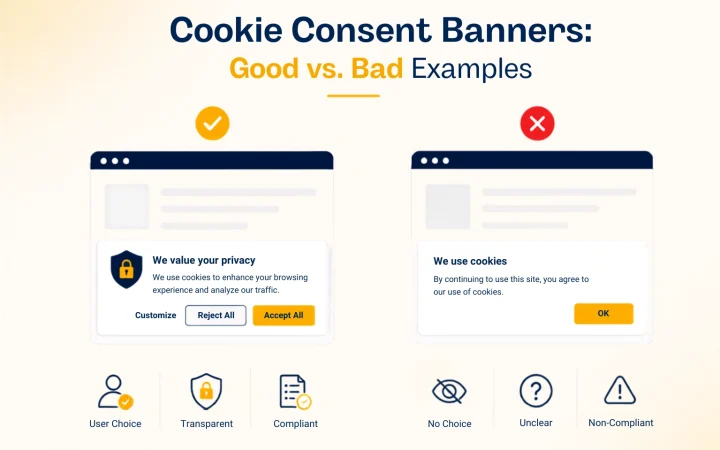
That’s the whole reason a well-built cookie banner has separate switches for each category instead of one big “Accept” button. Regulators in a lot of places have made it clear that lumping everything into one all-or-nothing choice doesn’t cut it anymore.
Frequently Asked Questions
No.A cookie is a plain text file that can’t execute code, install anything, or reach into your files. Whatever privacy concerns exist around cookies are about tracking and data collection, not your device getting infected.
Not really. Necessary cookies load no matter what you pick, but you can usually turn down functional, analytics, and marketing cookies and still use the site just fine.
You’ll get logged out of your accounts, lose any saved preferences, and whatever ad profile was built up from marketing cookies gets wiped. Nothing bad happens sites will just feel unfamiliar again for a bit until you log back in.
Not necessarily. A small personal blog might only bother with necessary and analytics cookies. A retail site running ad campaigns is far more likely to be using all four.
Not at all. You’ll still see the same amount of ads; they just won’t be built around your specific browsing history anymore.